Political Parties
09:39 AM | 19 May 2026
“It cannot pass”... “Forces”: Classifying diaspora writers as Syrians is an attempt to assassinate the Lebanese identity
Fady Mahouly
The Cultural Department of the Lebanese Forces’ Media and Communication Service issued the following statement:
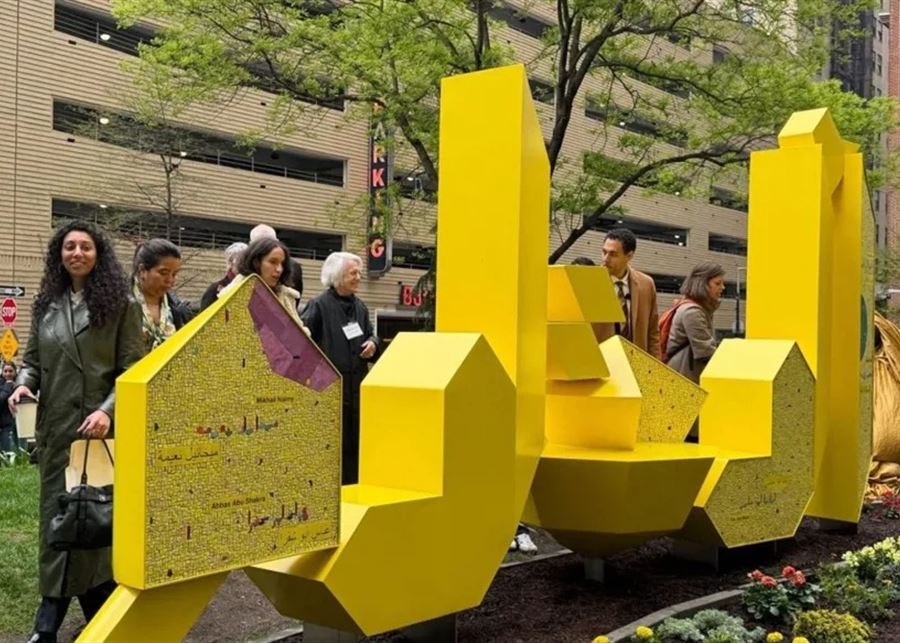
What happened in a public park in New York, with the classification of a number of Lebanese PEN pioneers as “Syrian poets and writers,” whether the reasons were ignorance or malice, is an attempt to assassinate Lebanese culture and identity, and it cannot go unnoticed.
After all these years that have passed, we regret that we are still trying to confirm what is certain, which is that the pioneers of diaspora writers, such as Gibran Khalil Gibran, Mikhail Naima, Elia Abu Madi, Rashid Ayoub, Afifa Karam, and others, are Lebanese, and belong to Lebanese towns and villages. Even though countries in their current sense were not geographically defined between the nineteenth and early twentieth centuries due to the Ottoman occupation, identities were known for hundreds of years. What is Lebanese is known, what is Syrian is known, and what is Palestinian is known as well. Whoever today tries to commit the crime of forgery knows very well that these poets and writers lived part of their childhood and youth on the 10,452 square kilometers of Lebanon, and their minds, imaginations and culture were absorbed by the customs and traditions of this land and the spirit of its people.
These “adults” from Lebanon migrated to the West under duress, under duress, to escape the oppression, ignorance, and corruption of the Ottomans. In New York, São Paulo, and Buenos Aires, they wrote texts in which they shaped Lebanon as a land of dreams, beauty, and freedom. This is diaspora literature, which we do not see as just a literary phenomenon or a passing literary current, but rather a laboratory for formulating a new identity for Lebanon, an identity that was formed in exile and then returned to impose its presence on the homeland.
This is what justifies the words of Gibran Khalil Gibran when he said: “If Lebanon were not my homeland, I would have chosen Lebanon as my homeland.” Rather, he praised his hometown of Bcharre, saying: “I owe everything I am and what I hope to be to those rocks, trees, and valleys that embraced my childhood. Bcharre taught me how to talk to God and how to listen.” Gibran went further in declaring his affiliation to Lebanon, saying: “Your patriotism, O Lebanon, runs in my blood, but you, O Human, reside in my heart and soul.” He also recommended that he be buried in Bsharri, and his museum and cemetery still bear witness to this affiliation, body and soul.
As for Elijah Abu Madi, he wrote one of the most wonderful poems about Lebanon, expressing his longing for it. He said: “Two things that time has tired of wearing out/Lebanon and the hope that its family has/We miss it and the summer on its hills/And we love it and the snow in its valley...”
Who is this person who tried to falsify the affiliation of these Lebanese geniuses who embraced the world with their pioneering ideas and works, which today constitute one of the pillars of a culture of peace based on equality between men and women, justice, freedom, democracy, faith, and peace among peoples?!
We must praise Lebanese Foreign Minister Youssef Raji, who showed remarkable interest in this issue that affects Lebanese identity, and began his contacts to address the matter immediately. We all believe that the land of Lebanon, despite all its pain, is still capable of inspiring and creating creative men and women in the world of culture and art, based on their Lebanese roots and identity.